Dancing increases BDNF

It has been known for some time that exercise modulates BDNF (brain-derived neurotrophic factor), losses of which are implicated in cognitive diseases i.e. dementia + Alzheimer’s .  Makes sense that dance does the same doesn’t it.  An article eloquently exploring the concept: Article

Wikipedia also has a fantastic article on BDNF if you’d like to learn more:

https://en.wikipedia.org/wiki/Brain-derived_neurotrophic_factor

A problem with Google-searching Health Issues, and Curriculums

One issue with formal education programs is that a curriculum can take many years to be changed despite evidence suggesting that information within the curriculum is outdated. Many students, at this moment in 2016, are being taught that an anterior pelvic tilt is strongly correlated with low back pain, when the latest scientific evidence suggests otherwise.  In addition, a Google search might lead the general public in that direction as well.

A more nuanced and up-to-date thinking approach can be found however, if one looks in the right places.  The following being one of them, an article from Better Movement:

http://www.bettermovement.org/blog/2012/does-anterior-pelvic-tilt-cause-low-back-pain

Lorimer Moseley – Rockstar of Pain Science

The TED Talk shown above is both excellent and entertaining, especially for a topic that can be “painfully” dry.  Here are some other notable Moseley quotes:

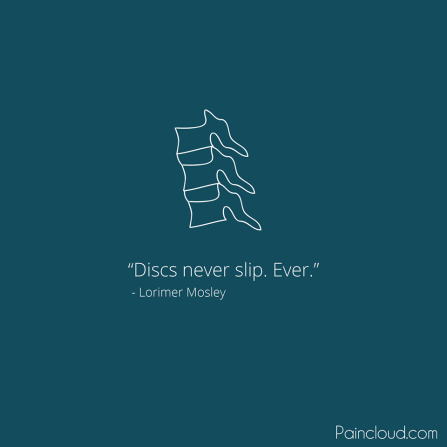
-Thinking that we have a slipped disc has the potential to increase back pain. But what if this piece of knowledge we have stored is inaccurate, just like our notion of a slipped disc? A disc is so firmly attached to its vertebrae that it can never, ever slip. Despite this, we have the language, and the pictures to go with it, and both strongly suggest it can.

-When the brain is using this inaccurate information to evaluate how much danger one’s back is in, we can predict with confidence that, if all other things were equal, thinking you have a slipped disc and picturing one of those horrible clinical models of a slipped disc will increase your back pain.

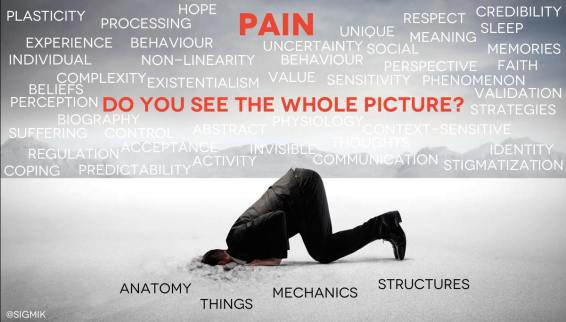
-The evidence that tissue pathology does not explain chronic pain is overwhelming, in back pain, neck pain, and knee osteoarthritis for example.

-Yet we continue to avoid the truth that tissue damage, nociception and pain are distinct. I would go so far as to suggest that even the use of these erroneous terms – pain receptors, pain fibers and pain pathways – leaves the patient with chronic pain feeling illegitimate and betrayed, and leaves the rehabilitation team lacking credibility when they look beyond the tissues for a way to change pain.

Greg Lehman – “No Ideal Posture/Positions”

Greg Lehnman is a physiotherapist and chiropractor, and has a popular blog.  He denounces the poor science of “text-neck” in this article, hinting that there isn’t really an “ideal posture”:

http://www.greglehman.ca/2014/11/22/text-neck-is-bad-science-and-fear-mongering/

This is also a good article, in which he questions the validity of the perhaps outdated “lower-crossed syndrome”.

http://www.greglehman.ca/2016/01/11/jandas-lower-crossed-syndrome-has-not-been-validated/

Non-neutral joint positions + external load

Very important to keep this in mind when performing tasks at work or exercises that require non-neutral joint positions for extended periods of time:

Excerpts taken from an excellent review paper entitled: Pathophysiology of Nerve Compression Syndromes: Response of Peripheral Nerves to Loading. http://ergo.berkeley.edu/docs/1999rempeljbjs.pdf

“The findings that non-neutral joint positions and external load (for example, during pinch grip) can affect extraneural pressure, combined with the findings from the animal studies, can guide our understanding of the pathogenesis of nerve entrapment related to loading. On the basis of the animal studies, it appears that if elevated extraneural pressures are maintained for an adequate duration the initial injury, remodeling, and repair mechanisms, which are constantly ongoing, may be overwhelmed, leading to persistent extraneural or intraneural edema and eventually to synovial or intraneural fibrosis and loss of nerve function. However, the precise characteristics of this critical time-pressure threshold remain to be determined.”

“Edema was visible in the subperineurial space within four hours in all compression subgroups, and it persisted for the entire duration of the study. Inflammation and fibrin deposits occurred within hours after compression, followed by proliferation of endoneurial fibroblasts and capillary endothelial cells. Vigorous proliferation of fibrous tissue was noted within days, and marked fibrosis and sheets of fibrous tissue were seen extending to adjacent structures at twenty-eight days. Endoneurial invasion of mast cells and macrophages was noted, especially at twenty-eight days. Axonal degeneration was noted in the nerves subjected to 10.7 kilopascals of compression and, to a lesser extent, in those subjected to 4.0 kilopascals of compression. It rarely was seen in the nerves subjected to 1.3 kilopascals of compression. Axonal degeneration was associated with the degree of endoneurial edema. Demyelination and Schwann-cell necrosis at seven and ten days was followed by remyelination at fourteen and twenty-eight days. Demyelination was prominent in the nerves subjected to 4.0 kilopascals of compression and, to a lesser extent, in those subjected to1.3 kilopascals of compression. The sham intervention in which the cuff was applied but not inflated also led to demyelination in regions close to the surface of the cuff; this was thought to be due to the tense but uninflated rubber cuff pressing on the nerve. The sham operation in which no cuff was applied did not cause any lesions. This study62 and another16 demonstrated that relatively brief periods of extraneural compression result in very long-lasting subperineurial edema, which later is accompanied by degeneration and regeneration of nerve fibers and initiation of the permanent changes of the laying down of fibrous tissue. Again, there was a dose-response relationship between the amount of pressure and the severity of the effects”
Running Economy improved by Strength Training

Meta-analysis cementing the popularly held notion that highly-trained runners (a 60 VO2 Max is quite fairly high by the way), can improve their running performance through strength training.

http://www.ncbi.nlm.nih.gov/m/pubmed/26694507/

Spinal Manipulation: Pros, Cons, Mechanisms of Action

Discs never slip

Pros: There is evidence that suggests that spinal mobilizations a.k.a. manual therapy a.k.a. chiropractic adjustments a.k.a. high-grade joint play, can have interesting neurophysiological (mind-body) effects, albeit by not actually structurally altering the spine in any way.  Vertebrae don’t shift or slide or “sublux” spontaneously.   Jason Silvernail has aptly stated that, “Spinal mobilization engages several pain relief mechanisms in the body primarily through neuromodulatory and endocrine pathways – not through affecting structure of the joints or effecting connective tissue through direct structural change.”

Mechanisms of Action of Spinal Mobilization: http://www.ncbi.nlm.nih.gov/pubmed/26751060/

“Evidence suggests that spinal mobilizations cause neurophysiological effects resulting in hypoalgesia (local and/or distal to mobilization site), sympathoexcitation, and improved muscle function. Mobilizations have no effect on temperature pain threshold. Three of four studies reported reduction in spinal stiffness, heterogeneous in location and timing. There is limited evidence (one study in each case) to suggest that mobilizations produce increased nociceptive flexion reflex threshold, improved posture, decreased concentration of substance P in saliva, and improved sway index measured in cervical extension. Evidence does not support an effect on segmental vertebral movement.”

Cons: At about 13:15 – Harriet Hall describes how cervical (neck) manipulation is involved in causing tears in the delicate lining of the vertebral arteries, which can cause clots, which can lead to strokes.  One estimate posits that 20% of basilar strokes, or 1300 strokes in the U.S. per year, are caused by cervical spinal manipulation…and this could actually be an under-reporting of the numbers, because neurologists might not inquire about prior cervical manipulation upon meeting a patient.

Conclusion:  Manipulation might be useful in helping patients get out of pain, and return to function, however, cervical (neck) manipulation should probably be avoided.

Static Stretching: “Stretching” the Truth

PainScience: Full Article

Stretching research clearly shows that stretching is not an effective warmup

“Nothing about static stretching is more clear. Your basic quick (static) stretch warmup is one of the most studied topics in all of musculoskeletal health care and exercise science. For instance, a huge 2011 review of all the research found “overwhelming evidence that stretch durations of 30-45 seconds … imparted no significant effect” and even some evidence of harm.13

Um, harm? Yep: a 2014 test found that a nice pre-run stretch causes “a reduced capacity of the skeletal muscle to produce explosive force.” Yikes! As Alex Hutchinson put it for Runner’s World, “I can’t see anything good about something that makes me go slower but feel like I’m trying harder.”

“Acrobats, gymnasts, yogis, contortionists, and martial artists have clearly been pushing the limits for centuries, sometimes achieving uncanny mobility. But these are highly motivated athletes with specific and exotic performance goals and stretching regimens that woulddefinitely intimidate the rest of us, and with good reason: they often injure themselves along the way. Indeed, it may even be necessary to injure joints — to traumatize their capsules and ligaments — in order to get them to move that far.

Fitness and health are not equivalent. You can be fit for a particular athletic pursuit, but that doesn’t mean you are a healthier person: high performance in a narrow category often comes at great costs (such as joint stability). Flexibility is “good for” a few things … and really not much else. It’s useful for gymnasts, for instance …”