Dose-Response Relationship – Exercise and Mortality

The Dose-Response relationship with regards to mortality rates is an important concept.

The following review, link to review, was published in JAMA Internal Medicine and came to the following conclusions:

Conclusions and Relevance  Meeting the 2008 Physical Activity Guidelines for Americans minimum by either moderate- or vigorous-intensity activities was associated with nearly the maximum longevity benefit. We observed a benefit threshold at approximately 3 to 5 times the recommended leisure time physical activity minimum and no excess risk at 10 or more times the minimum. In regard to mortality, health care professionals should encourage inactive adults to perform leisure time physical activity and do not need to discourage adults who already participate in high-activity levels.


Hormesis or the Biphasic Dose Response

The biphasic dose response, aka hormesis, aka proper dosage, aka the “sweet spot”, is an incredibly important concept in all-things medicinal and/or health related.  It is the phenomenon whereby low-levels or small amounts of a stressor (ex. exercise, alcohol, curcumin/turmeric) can have beneficial or pro-adaptive properties.

Biphasic Dose Response

Neuroplasticity + Norman Doidge

Pretty remarkable stuff. Norman Doidge, featured in this video, who has been responsible for getting the concept of neuroplasticity into the maintream, was also responsible for kick-starting my interest in LLLT(low-level lasers)/photomedicine (I however use it strictly for musculoskeletal conditions).

He is featured here in a Nature of Things episode on the CBC.  The concept of neuroplasticity is changing the way that schizophrenia, PTSD and OCD are being treated.

http://www.cbc.ca/natureofthings/episodes/changing-your-mind

Low-back pain: Linked to Depression

“Individuals with symptoms of depression have an increased risk of developing an episode of LBP in the future, with the risk being higher in patients with more severe levels of depression”

In a recent systematic review and meta-analysis (link), the results suggested that low-back pain and depression are correlated.

Nutritional Epidemediology: A Mess

Nutritional epidemiology is a stickier than molasses because of the innumerable confounding variables present in studies on food consumption.  This article is excellent You Can’t Trust What You Read About Nutrition , and here are my favorite excerpts from it:

“A few years back, Jorge Chavarro, a nutritional epidemiologist at the Harvard School of Public Health, advised that women trying to conceiveconsider swapping low-fat dairy foods for high-fat dairy products such as ice cream, based on FFQ data from an ongoing study of nurses. He and his colleague Walter Willett also wrote a book promoting a “fertility diet” based on the results. When I reached Chavarro this week to ask how confident he was in the link between dairy intake and fertility, he said that “of all the associations we found, this is the one we had the least confidence in.” It’s also, of course, the one that made headlines.

Nearly every nutrient you can think of has been linked to some health outcome in the peer-reviewed scientific literature using tools like the FFQ, said John Ioannidis, an expert on the reliability of research findings at the Meta-Research Innovation Center at Stanford. In a 2013 analysispublished in the American Journal of Clinical Nutrition, Ioannidis and a colleague selected 50 common ingredients at random from a cookbook and looked for studies evaluating each food’s association to cancer risk. It turned out that studies had found a link between 80 percent of the ingredients — including salt, eggs, butter, lemon, bread and carrots — and cancer.”

Jason Silvernail: Paradigm-shifter

Jason Silvernail is a prominent voice in the world of physiotherapy and pain science, and argues that while biomechanics has some value in terms of understanding pain, that value has been largely overrated.  It has now come to our attention that pelvic tilt, core strength, and “postural abnormalities” are perhaps trivialities when understanding a patient’s pain.

Jason Silvernail

“Every time pain science gets discussed there are always people who push back and it’s nearly always, acknowledged or not, the straw man of “biomechanics doesn’t matter.” No one has said that biomechanics doesn’t matter. Mechanical origin pain by its nature is biomechanical and the concepts of neurodynamics are also.

The problem is that people have been trained to think things like pelvic tilt and core weakness and short muscles are significant biomechanical problems that must be creating a large nociceptive drive that therefore pain science discussions ignore nociceptive pain. But we need to put biomechanics “in its place” not “out of our mind” when thinking about pain.

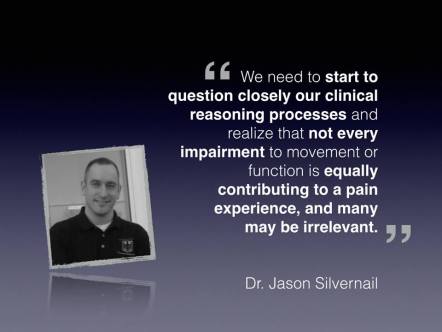
We need to start to question closely our clinical reasoning processes and realize that not every impairment to movement or function is equally contributing to a pain experience, and many may be irrelevant. We discover which ones are relevant and worth correcting through a systematic assessment and reasoning process – two of the most common and most supported by randomized trials are the McKenzie MDT system and the Maitland manual therapy system.

What we don’t do is assume every kind of positional, movement, muscle length or strength, nerve mobility, or joint accessory movement impairment is contributing nociceptive drive.

And that they all need to be addressed and that acknowledging the published research evidence that many of these impairments are normal findings unrelated to the pain experience is somehow ‘ignoring biomechanics’. It’s a testament to how indoctrinated people are into the biomedical model that their concept of pain begins and ends with their ability to find things to blame and fix in the patients body.

I for one won’t apologize for trying to move people in the fitness and rehabilitation world away from such a simplistic, practitioner-centered, outdated view to a more complex, patient-centered, and modern view of the pain experience.

If people want to say that means ignoring biomechanics we will just have to keep pointing out this strawman argument when we see it – but I am really sick to death of this particular canned response. ” Dr. Jason Silvernail, DPT

Information asymmetry

Brilliant article written by Apply Research: Article.

– “Information asymmetry” is a overlooked problem in health care. Kenneth Arrow, a Noble Prize winner in Economics, described the phenomenon as the severe disadvantages that people face when they know less about a commodity than the seller does.

This holds true in many aspects of life. From banking to housing, from couches to cars. Yet, one of the most frightening displays of competency difference is seen in health care.

The gap between the knowledge of the clinician and most patients´ proficiency to understand health information is so vast, that patients face gruelling odds [1]. An alarming minority of patients is actually able to receive, analyse and interpret information critical for their own health and well-being. In other words, patients are by all accounts totally and unequivocally at the mercy of the clinician in front of them.

This raises some serious dilemmas. Clinicians can recommend care of little or no value because:

  • It is financially rewarding
  • It is easy and it keeps patients satisfied
  • Professional indolence has caused auto-pilot habits
  • They genuinely (but incorrectly) believe in the actual service they are providing

For decades health literacy has allowed clinicians to assume a God-like status. Even in cases where evidence is scarce or completely missing, clinicians can quietly build a bubble of self-glorification without protest or scrutiny.

Musician’s Dystonia and Movement Variability

Extreme repetition of a movement pattern, or doing the same movement in the same manner for a long time, might actually cause motor neurons to “burn out”.

“Musician’s dystonia (MD) is a neurological motor disorder characterized by involuntary contractions of those muscles involved in the play of a musical instrument. It is task-specific and initially only impairs the voluntary control of highly practiced musical motor skills.”

http://www.ncbi.nlm.nih.gov/pmc/articles/PMC3691509/

Variability of movement is good.  And perhaps essential when dealing with chronic pain.  This is a brilliant Cor-Kinetic article detailing this concept.  The article is rather damning of the FMS (Functional Movement Screen).  Ingraham of PainScience has spoken about the problems with FMS: PainScience FMS article

Some of my favourite excerpts from the Cor-Kinetic article:

“Decreased ability to move differently and have other movement options has been associated with the transition from an acute injury to chronicity”.

“Simply altering foot positions in a squat or a lunge will adjust femoral orientation in the acetabulum and provide a different stimulus to both the tissues of the hip and the CNS for a different response – hopefully less pain.”

“In a pain situation the aim may simply be to move with less pain rather than targeting a specific muscle to make it stronger. I would hope we are now moving away from a single muscle weakness as a cause of pain or biomechanical ‘dysfunction’.  The more you move in the same way with pain the more you are likely to trigger the same response. The painful movement could look like ‘really good’ movement and ‘really bad’ movement could be pain free. We need to get MORE comfortable with being able to adapt exercises and movements to the person rather than shoehorning them into an ‘ideal’ version of an exercise.”

“Essentially some peoples CNS’s get very good at being in pain! So pain is very easy to trigger and because it is easy to trigger people become both aware and wary of this. We see this with hyper vigilance and fear avoidance. Being able to find pain free movements with these people becomes of huge value far outweighing if it is the ‘right’ exercise performed in the ‘right’ way. If we can also make movement relevant to the person then the psychological value is going to be significant. Fear avoidance is in part is maintained by avoiding perceived pain situations and therefore not getting pain, the relevance of movement and the dosage of how we interact is paramount. Not addressing relevant movement may sustain the problem.”

“Movement also promotes basic fluid dynamics that can take away the nasty stuff and bring in good stuff so not moving is generally not the answer. Movement is also analgesic *HERE* An increase in corticomotor output promoting descending inhibition and an increase in endogenous opioid production have both been discussed as potential mechanisms. The more inhibitory chemicals we have floating around the spinal cord the less sensitive it is likely to be, this includes chemicals such as GABA and endogenous opioids. This top down inhibition can influence what’s happening physiologically within the tissues and even simply having positive associations with movement may have an inhibitory effect on pain.”